AI is increasing output across distributed and hybrid teams, but quietly slowing how people learn, think, and grow into leadership — creating a gap most organizations haven’t recognized yet.
There’s something happening right now that I don’t think we’re talking about enough.
AI is making teams faster, more efficient, and more capable. But underneath that progress, there’s a quieter shift happening — one that’s much harder to see. We’re getting better at producing work, and worse at developing the people who will lead it.
There’s a broader idea here that I’ve written about before — AI isn’t replacing people, it’s amplifying how organizations operate.
 AI Is Testing Leadership — and Talent
But there’s a second-order effect I’ve been thinking more about recently: not just how AI impacts performance, but how it impacts how we develop people.
I saw this firsthand while leading a fully distributed team of over 100 designers. The team was strong — smart, capable, and delivering high-quality work. On paper, everything looked like it was working, but something felt off.
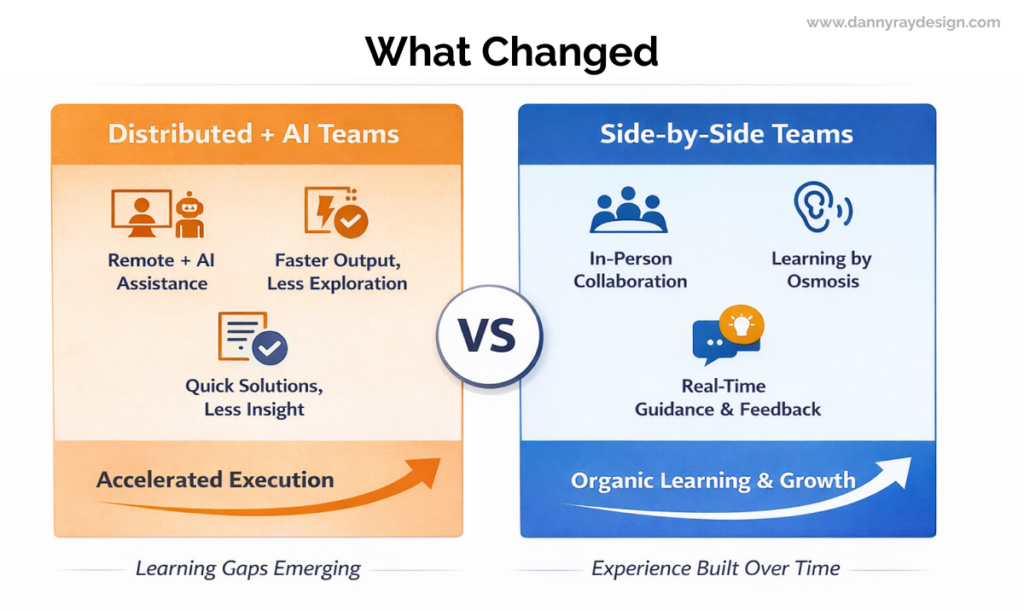
The junior designers were improving their output, but not at the pace we would expect if they were working side by side with more experienced team members. Progress was happening, but more slowly — especially in how they developed their thinking. They asked fewer questions and had fewer opportunities to observe how experienced designers approached complexity. While they could arrive at solid solutions, it took longer to build the deeper understanding behind why those solutions worked or what tradeoffs were being made.
When teams are working side by side, a lot of learning happens through exposure. You overhear how someone navigates a difficult conversation, sit in on meetings where decisions get messy before they get clean, and ask quick questions that turn into lessons you carry for years. In distributed teams, that kind of learning has to be created intentionally — it doesn’t just happen.
At the same time, AI is removing another critical ingredient: struggle. Before, when someone hit a wall, they had to work through it. They would try a few approaches, get stuck, ask for help, and gradually build the mental models that make someone effective over time. Now, they prompt, get an answer, and move on. It’s efficient, but it’s not the same as learning.
Research on deliberate practice, particularly from Anders Ericsson, reinforces that mastery comes from effortful learning — not just arriving at the right answer quickly.
We’re Scaling Output Faster Than We’re Scaling Judgment
This is the real issue.
We’re creating a generation of employees who can execute at a high level, but may not yet have the depth of understanding to operate without the tools they rely on. They can produce results, but they haven’t always built the instincts that come from wrestling with problems, making decisions, and seeing how experienced people navigate complexity.
Leadership isn’t about having answers — it’s about knowing how to think when the answer isn’t obvious. That’s the part at risk. There’s already growing discussion in Harvard Business Review around how AI can improve output while weakening deeper understanding if it replaces, rather than supports, human thinking.
Experience Still Shows Up — Even in AI
I had a moment recently that reinforced this for me in a different way.
While working through my master’s program, I shared one of my ChatGPT threads with a few peers — some of whom hadn’t yet moved into management roles. One of them pointed out something I hadn’t noticed: my prompts were shorter, more direct, and I was getting to useful results faster with less back-and-forth.
At first, I assumed it was just familiarity with the tool. But the more I thought about it, the more it became clear that it wasn’t really about ChatGPT at all — it was about experience.
I’ve spent years directing teams — framing problems, giving clear guidance, and understanding what matters and what doesn’t. That way of thinking showed up naturally in how I interacted with AI. The brevity wasn’t about efficiency alone; it came from knowing how to articulate intent clearly and move toward an outcome.
That clarity is built over time. It comes from doing the work, making decisions, seeing what works and what doesn’t, and learning how to navigate tradeoffs.
That’s when it really clicked for me: AI doesn’t remove the need for experience — it reveals it. The difference isn’t the tool. It’s the thinking behind it.
The difference isn’t the tool. It’s the thinking behind it.
The System Hasn’t Caught Up
When I started to see this pattern, I raised it as a structural concern — not as a training gap, but as a long-term leadership risk. If we’re not developing thinking, we’re not developing leaders.
The response was slow. Not because people didn’t care, but because most organizations are still operating on an outdated model of growth — one that assumes learning happens naturally over time through exposure. That assumption doesn’t hold in distributed teams supported by AI.
This mirrors a broader pattern I’ve written about in Adaptive UX — systems that fail to evolve alongside changing behavior eventually break down.
So we designed our own approach.
What I Tried to Put in Place
When I started to see this pattern, I raised it as a structural concern — not just a training gap, but a long-term leadership risk.
I pushed for more intentional systems: mentorship pairings, shared learning environments, and structured opportunities for junior team members to learn from more experienced designers. The goal was to recreate, in a distributed setting, the kinds of exposure and growth that used to happen more naturally.
But those changes didn’t fully materialize at the organizational level.
That’s not unusual. Most systems aren’t designed to adapt this quickly, especially when performance still appears strong on the surface.
So I focused on what I could influence directly.
I leaned into my leaders to create more visibility into their thinking — encouraging walkthroughs, shared context, and more openness in how decisions were made. And personally, I made a point to step back into the work on a regular basis.
About once a month, I would take on a problem — not to review it or direct it, but to show how I approached it. I’d walk through how I framed the problem, where I focused, how I simplified it, and how I moved efficiently without cutting corners.
Then I’d get my hands on the mouse, open up Photoshop or Figma, and walk-the-walk in real time. Not describing it — doing it.
This wasn’t formal training — it was demonstration. And it made a difference.
It built trust with the team, created a clearer sense of what “good” looked like, and gave people a window into how experienced designers think through problems. In a distributed environment, those moments of visibility became one of the most effective ways to accelerate learning.
If Osmosis Is Gone, We Have to Replace It
What used to happen passively now has to be designed intentionally.
That means creating environments where people can see how decisions are made, not just the outcomes. It means encouraging people to explain their thinking, not just deliver results. It means using AI as a tool, but not as a substitute for understanding.
It also means creating space for productive struggle. Struggle isn’t inefficiency — it’s how people learn to think.
Designed Development: Building Learning Into the System
If passive learning is no longer happening naturally, then we have to design for it.
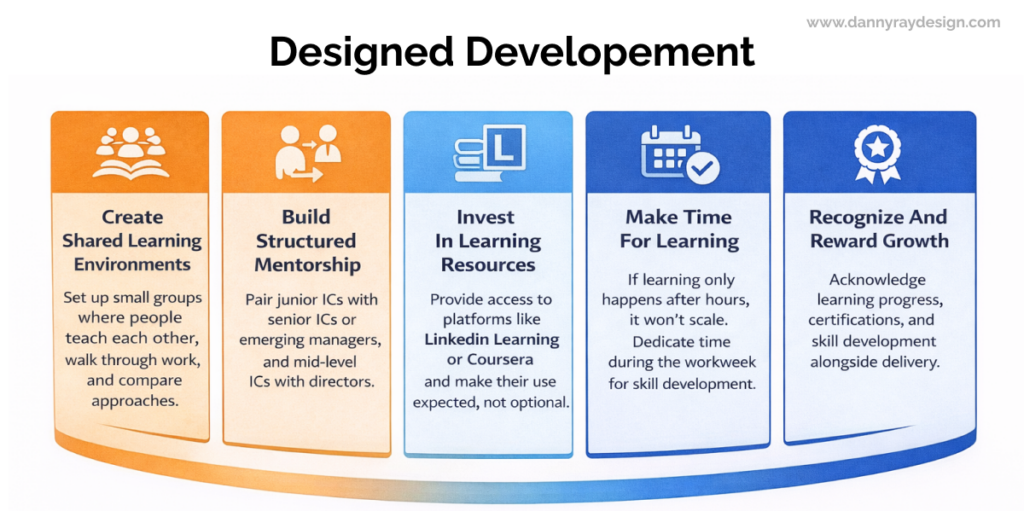
This is what I think of as Designed Development — an intentional approach to building learning into how teams operate, rather than hoping it happens over time. It doesn’t require a massive transformation to get started, but it does require focus.
A few ways to begin:
- Create shared learning environments.
Set up small groups where people teach each other, walk through work, and compare approaches. Teaching reinforces understanding. - Build structured mentorship.
Pair junior ICs with senior ICs or emerging managers, and mid-level ICs with directors. This develops both learners and future leaders. - Invest in learning resources.
Provide access to platforms like LinkedIn Learning or Coursera and make their use expected, not optional. - Make time for learning.
If learning only happens after hours, it won’t scale. Dedicate time during the workweek for skill development. - Recognize and reward growth.
Acknowledge learning progress, certifications, and skill development alongside delivery.
The Shift
This isn’t complicated, but it does require a mindset change.
We have to stop treating learning as something separate from work and start treating it as part of how work gets done. In distributed, AI-assisted teams, if you don’t build learning into the system, it won’t happen consistently — and over time, that gap compounds.
This Is a Leadership Problem, Not Just an HR Problem
HR plays a role, but this doesn’t get solved through programs alone. It comes down to how leaders show up — whether they narrate their thinking, stay connected to the work, and create opportunities for others to learn, even when it’s less efficient in the moment.
Without that, the risk is subtle but real: we promote people who deliver, but haven’t fully developed how they think.
Where This Goes If We Don’t Address It
If we continue optimizing for speed and output without redesigning how people learn, the impact will show up over time. Decision-making slows, confidence under ambiguity drops, and leaders become overly reliant on tools.
You can’t prompt your way into leadership.
The Opportunity
AI and distributed work aren’t the problem — but they’ve changed the environment. If we don’t adapt how we develop people, we won’t just accelerate performance — we’ll accelerate the gaps.
In my previous piece, I argued that AI amplifies organizations. That’s still true, but amplification cuts both ways. If we don’t rethink how we build leaders in this environment, we won’t just move faster — we’ll move faster in the wrong direction.