

AI is often talked about as a shortcut. It can write faster, summarize faster, generate concepts faster, produce code faster, create variations faster, and help teams move through routine tasks with far less friction than before. For many people, that creates an easy assumption:
If AI can do more of the work, people may not need to know as much.
I think the opposite is true. AI may make output easier to generate, but it makes judgment harder to fake. The more AI touches the work, the more important it becomes for leaders to understand what that work connects to, where it goes next, what systems it depends on, and how to evaluate whether the result is actually useful.
A generated design concept is not just a design concept. It may connect to a design system, accessibility standards, content strategy, front-end implementation, product requirements, analytics events, brand governance, or a larger customer journey. A research summary is not just a summary. It may shape product strategy, roadmap decisions, prioritization, messaging, segmentation, or executive alignment. A code prototype is not just a prototype. It may influence technical assumptions, handoff expectations, stakeholder confidence, or the way a team thinks about feasibility.
That is why AI is not making leadership simpler. It is making leadership more demanding. The risk is not that AI will produce work; it will. The risk is that teams and leaders will move faster than their ability to understand, question, and improve what AI produces.
That is where judgment becomes more important, not less.
The challenge with AI-generated work is that it rarely stays isolated. A concept, summary, prototype, campaign variant, or code suggestion eventually has to move into a larger system of people, tools, standards, and decisions. That is where leadership judgment starts to matter most.
If AI helps generate a landing page, the question is not only whether the page looks good. Does it use the right components? Does it align with the design system? Can it be built within the CMS? Does the content model support it? Are the analytics events clear? Is the experience accessible? Does it support the business goal without creating confusion for the user?
If AI summarizes research, the question is not only whether the summary is well-written. What did it flatten? What nuance did it miss? Were the right participants included? Are contradictions being treated as noise or as insight? Is the recommendation grounded in evidence, or did the AI simply make the research sound more decisive than it really was?
If AI generates front-end code, the question is not only whether it works in a demo. What is hard-coded? What depends on real data? Where does front-end behavior meet back-end logic? What would need to change before this could become production-ready? Who on the team understands enough of the system to know the difference?
These are not reasons to avoid AI. They are reasons to lead its use more deliberately. The more AI accelerates production, the more leaders need to understand the workflow around the production — not just the output itself.
Leading AI integration well starts before anyone chooses a tool. It starts with understanding the work itself: where ideas begin, how decisions are made, where handoffs happen, what slows the team down, where quality breaks, and where judgment is most important.
This is where many organizations get the order wrong. They start with the tool because the tool is visible, exciting, and easy to access. A new AI platform gets introduced, a few people experiment, a few use cases emerge, and the organization starts treating adoption as progress. But adding AI to a broken or poorly understood workflow does not automatically make the workflow better. In some cases, it simply helps the team move faster through the same confusion.
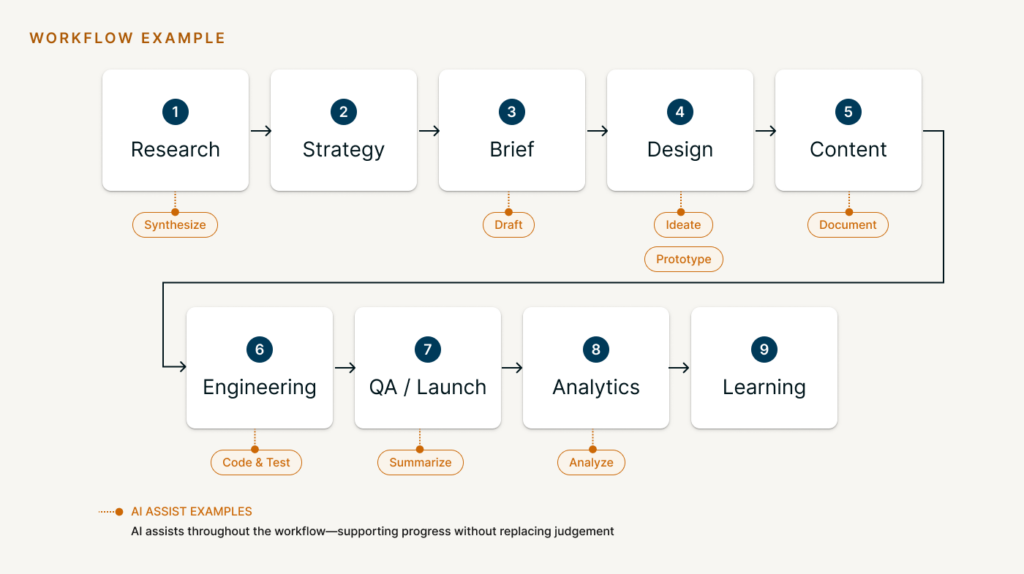
A better starting point is to map the current workflow before deciding where AI belongs. How does research move into strategy? How does strategy become a brief? How do design decisions get made? How does content enter the system? Where do design and engineering overlap? Where does data influence decisions? Where are teams repeating low-value work? Where are people waiting on inputs, approvals, documentation, or clarification?
Once leaders understand that path, AI becomes easier to place intentionally. It might help synthesize interview transcripts, generate first-pass content variations, document design system components, summarize analytics patterns, create prototype code, draft QA checklists, or explore campaign concepts. But each of those uses should connect to a real workflow need, not just a general desire to “use AI.”
A simple way to start is to ask four questions:
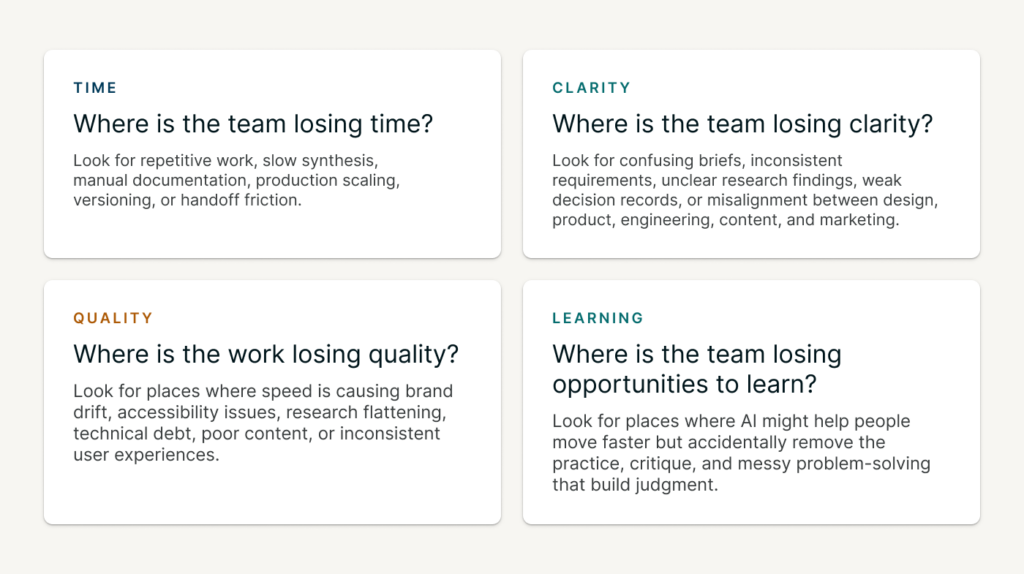
That last question matters. AI should not just help teams produce more work. It should help teams become better at understanding the work.
A UX research team might use AI to summarize interviews, cluster themes, tag transcripts, or draft a first-pass insight report. That can save time, but the team still needs to review the source material, challenge the themes, preserve contradictions, and decide what the research actually supports. AI can help organize the evidence, but it should not be allowed to turn messy human input into false certainty.
A design system team might use AI to draft component documentation, usage guidelines, accessibility checklists, QA notes, or code snippets. That can make the system easier to maintain, but designers and engineers still need to validate whether the component solves a real use case, works across products, fits the codebase, and supports the full range of interaction states.
A product design team might use AI tools to generate prototype code, explore alternate flows, or create lightweight demos for stakeholder alignment. That can accelerate learning, but the team still needs to understand what is hard-coded, what depends on real data, where front-end behavior meets back-end logic, and what the prototype does or does not prove.
A marketing or creative team might use AI to explore campaign concepts, content variations, imagery, localization drafts, or performance summaries. That can expand creative exploration and production capacity, but creative leaders still need to evaluate brand voice, originality, audience fit, legal risk, accessibility, and whether speed is improving the work or simply creating more of it.
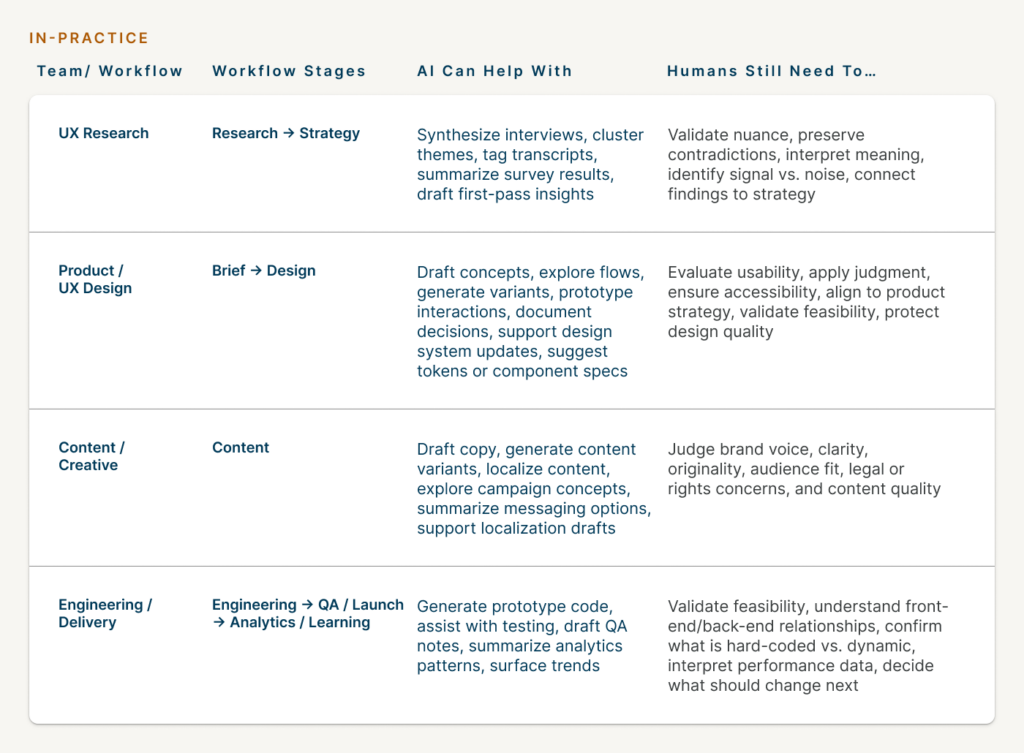
In each case, the leadership job is not simply to approve AI use. It is to define the role AI plays in the workflow, where human judgment stays in control, and how the team will learn from the process.
AI should not become a private shortcut where people generate work alone, hide the process, and only show polished outputs. If leaders want teams to build stronger judgment, AI use needs to become part of critique, review, and learning.
Ask what inputs shaped the output. Ask what the AI missed. Ask what the team changed and why. Ask what risks remain. Ask whether the output improves the user experience or only increases production speed. Ask junior team members to compare AI-generated options and explain which direction they would recommend.
That kind of review helps preserve the messy middle of the work: the part where people learn to compare options, defend decisions, understand constraints, and develop taste. If AI removes too much of that middle, leaders need to rebuild the learning moments somewhere else.
The opportunity is not to resist AI or blindly adopt it. The opportunity is to lead its integration with more intention. Use AI to accelerate the work, but build teams that can question it, direct it, evaluate it, and understand the systems it touches.
AI will not replace judgment. But it will expose where judgment is missing.