

Careers aren’t assigned — they’re designed.
Years ago, during an all-hands meeting, a department leader said something that has stayed with me:
“Your career path is up to you. Not me. Not your manager. You.”
It wasn’t dramatic, but it was clarifying.
Careers don’t unfold automatically. They aren’t distributed based on tenure, loyalty, or good intentions. They move when clarity meets contribution — when intent becomes visible and aligns with real opportunity.
That moment didn’t change how I approached my own growth — I’ve always believed ownership matters — but it sharpened how I led others. The professionals who progress aren’t the ones waiting to be chosen. They’re the ones designing their path.
Inside any organization, growth tends to happen at the intersection of three forces:
- Individual intent — what you want
- Team need — what the organization required
- Structural reality — what the business can support

When those align, momentum follows. When they don’t, frustration builds.
Alignment doesn’t happen by accident.
It starts with ownership.
Many early-career professionals assume that if they work hard and stay long enough, progression naturally follows. Hard work matters. But tenure alone doesn’t create a trajectory. Promotions are business decisions — based on need, value, and timing.
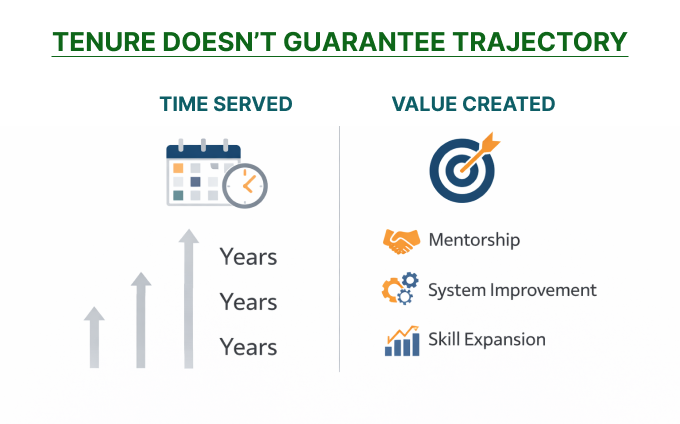
When leaders discuss advancement, the questions aren’t “Has it been long enough?” They’re more practical: Does the team need this capability? Will this person elevate performance at the next level? Is there an approved headcount? Will their growth strengthen the organization?
Those are structural questions.
One of the biggest disconnects I saw as a leader wasn’t lack of talent. It was a lack of clarity. Team members would quietly hope to move into management, strategy, or a new discipline — but never clearly state that intention. If leaders don’t know where someone wants to go, it’s difficult to help them get there.
That’s where Individual Development Plans came in.
When IDPs were first introduced to me, they felt like compliance documents — a template to complete and file away. The structure existed, but ownership didn’t.
So I redesigned mine.
Before asking my team to create one, I built my own as an infographic instead of a form. I incorporated my Myers-Briggs profile (INFJ) and mapped out who I am at my core. On one side, my strengths. On the other, my challenges — the tendencies that could limit me if left unchecked. Together, they revealed both opportunity and responsibility.
At the bottom, instead of listing a future title, I described the kind of impact I wanted to have and the leader I wanted to become.
Then I printed it and put it on my cubicle wall.
Visible.
It was a quiet signal: this is who I am, this is what I’m working on, and this is where I’m headed.
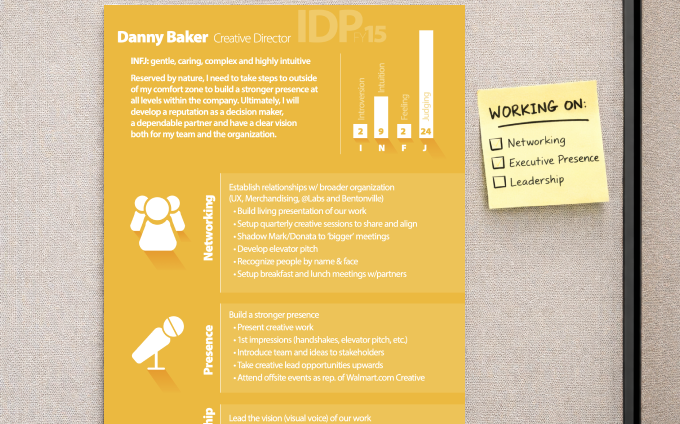
When the team saw that, development shifted from administrative to intentional. IDPs became design exercises — not about titles, but about value. What strengths should I double down on? What gaps are holding me back? What do I want to be known for contributing?
Because growth requires more than ambition. It requires contribution.
A promotion should expand capability — raising the bar, mentoring others, improving systems, increasing clarity. Advancement isn’t simply recognition for past effort; it’s an investment in future impact.
And then there’s timing.
Even when someone is ready, structural realities matter. There has to be a role. There has to be budget. There has to be space. Sometimes alignment exists immediately. Sometimes it takes time. Occasionally, the next step isn’t inside the same organization — and that’s okay.
Understanding that progression depends on alignment — not entitlement — removes much of the quiet resentment that can build. Timing isn’t always personal. Often, it’s logistical.
Believing careers are self-driven didn’t make me less supportive as a leader. It made me more intentional. My role became clarifying expectations, identifying gaps early, offering stretch opportunities, and having honest conversations about readiness.
The professionals who advanced most consistently weren’t waiting quietly. They were asking, “I’d like to move into X. What would that require?” That question transforms everything. Now we’re collaborating instead of guessing.
The professionals who progress aren’t waiting to be chosen. They’re designing their path.
Managers can guide you. Organizations can support you. Leaders can advocate for you.
But ownership is yours.
If you want to grow, start by getting clear:
- What do you want to be known for?
- What strengths should you double down on?
- What gaps are holding you back?
Say it out loud. Write it down. Make it visible. Ask what it would take. Volunteer for the stretch assignment. Seek the feedback before it’s offered.
Momentum begins the moment your intent becomes tangible.
Careers aren’t assigned. They’re designed. They move when clarity meets contribution — when your ambition aligns with real value for the team. When you stop waiting to be discovered and start building the capability that makes you undeniable.
And when intent meets opportunity, growth doesn’t feel lucky.
It feels earned.
It feels aligned.
And it feels like forward motion.