

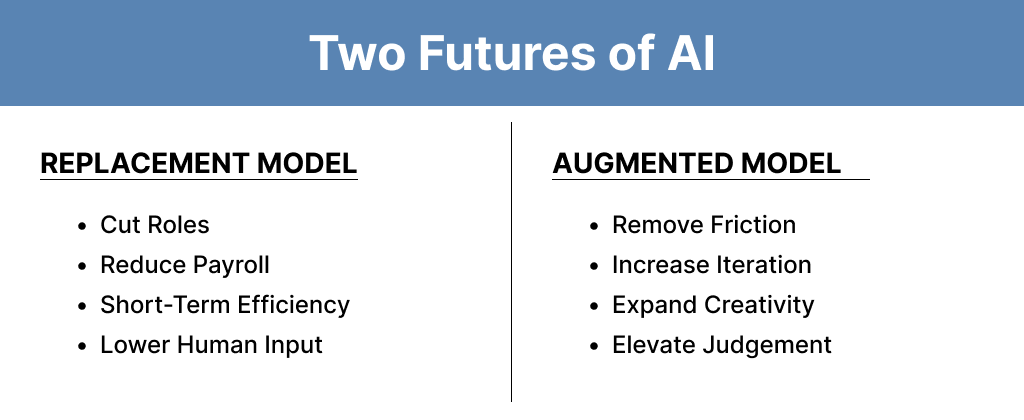
How organizations respond to AI will determine whether it replaces people — or elevates them.
Every week there’s a new headline about AI replacing workers. Entire departments “automated.” Creative work “generated.” Knowledge roles “at risk.” The narrative is simple and easy to fear: AI is here to take your job.
But that framing misses something deeper.
AI isn’t inherently a replacement engine. It’s a leverage engine. And whether it replaces people or empowers them depends almost entirely on how leaders choose to use it.
The First Time I Saw This Tension
I experienced this years before ChatGPT became a household name.
At the time, I was leading a design and marketing team at a disruptive publishing company operating in classic startup mode — where speed, iteration, and revenue timing mattered. In that environment, velocity isn’t a luxury; it’s survival.
I began experimenting with an early AI-powered tool designed to accelerate content development. It wasn’t flashy, and it didn’t “write books.” What it could do was generate structured outlines, frameworks, and variations far faster than traditional processes allowed.
I encouraged the broader editorial and outlining teams to explore it. The pushback was immediate.
The concern was understandable: if this tool can generate outlines, what happens to us?
The tool wasn’t mandated or rolled out company-wide. The editorial and outlining teams largely chose not to adopt it, though a few experimented quietly. The only group that meaningfully embraced it was the team reporting directly to me. Even then, we used it cautiously — in testing mode, primarily for product detail page content and marketing experimentation.
What we discovered was revealing.
Instead of spending weeks building a single structured direction, we could generate multiple variations quickly. Instead of debating hypotheticals, we could test options. Instead of polishing one path endlessly, we could compare ten and refine the strongest.
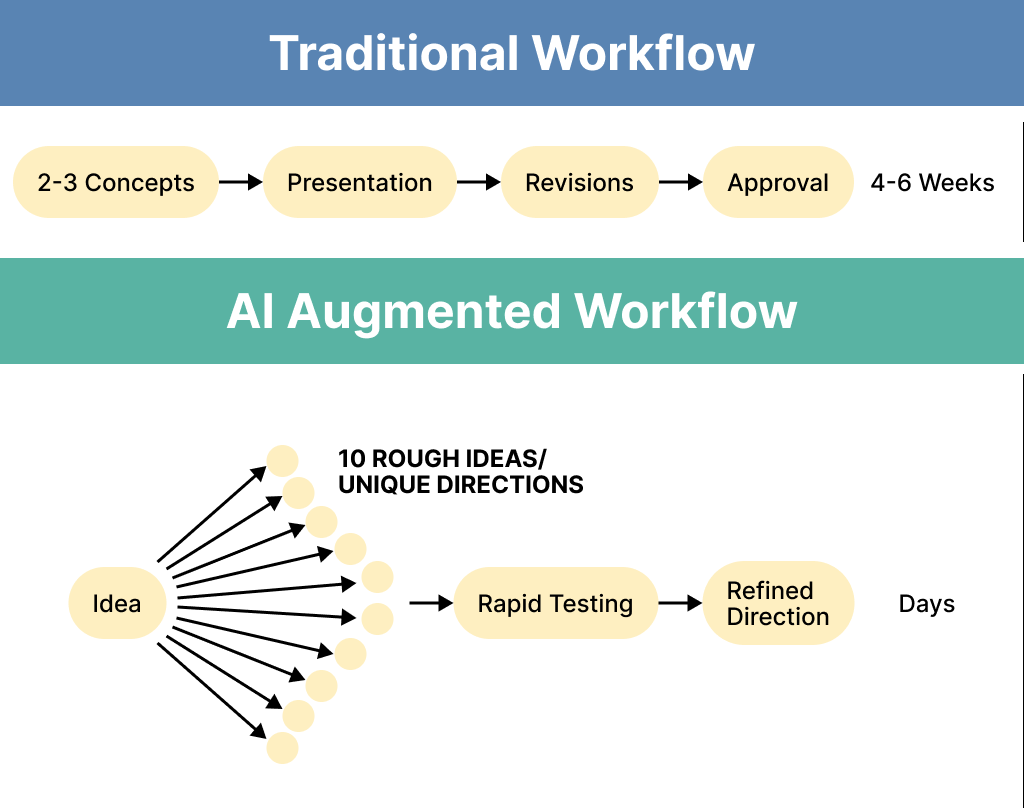
The tool didn’t eliminate creative thinking. It accelerated iteration. It created optionality. It increased leverage.
But without broader adoption, that leverage remained localized. The organization continued operating at its traditional pace.
I reflect on that moment often — not with blame, but with curiosity. In a startup, velocity compounds. What happens when iteration accelerates across departments? What happens when experimentation becomes cheaper? What happens when teams can explore twenty pathways instead of one?
I can’t say wider adoption would have changed the company’s trajectory. But I do know the opportunity to multiply output without multiplying headcount was there. The hesitation wasn’t about capability — it was about fear.
That experience shaped how I see the AI debate today.
The Real Fork in the Road
The conversation now is framed around replacement: AI writes. AI designs. AI analyzes. AI automates.
But the real fork in the road isn’t automation versus humanity. It’s intention.
Leaders effectively face two paths.
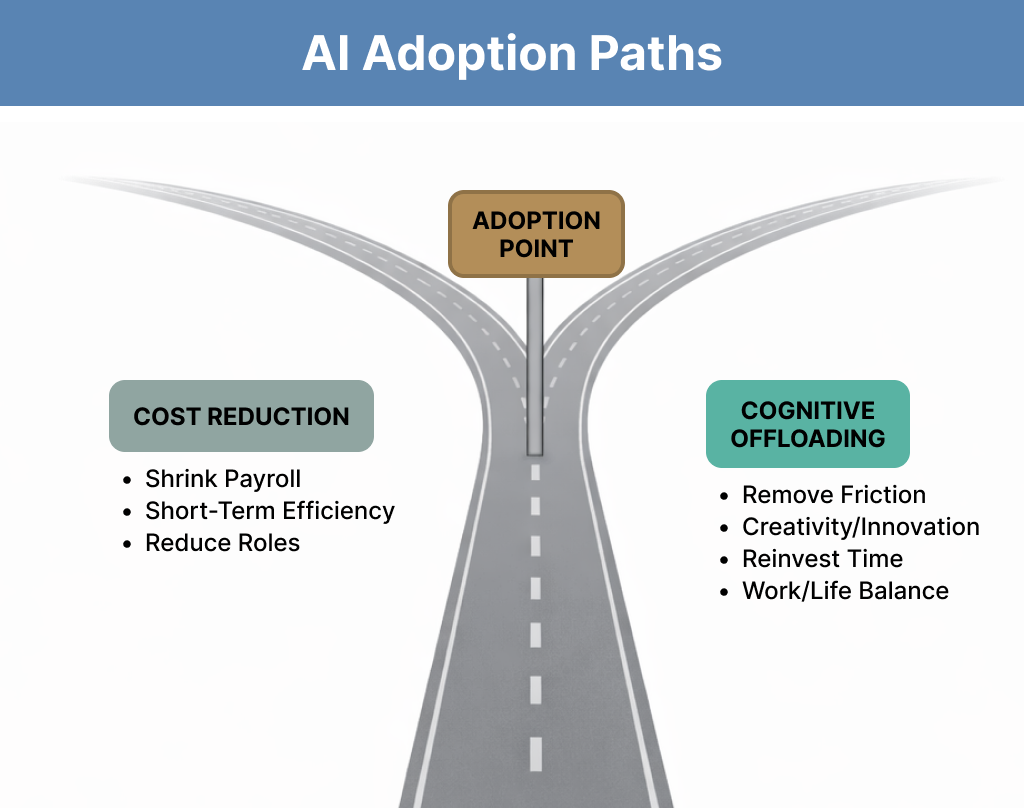
Side-by-side image of a professional multitasking with phone, laptop, and paperwork appearing overwhelmed, contrasted with a calm professional working thoughtfully at a desk, representing the difference between cognitive overload and focused productivity.The first is cost reduction: use AI to shrink payroll, optimize short-term efficiency, and reduce roles wherever possible. Some organizations will take this path.
The second is cognitive offloading: use AI to remove repetitive, low-leverage work, free people from administrative friction, and reinvest saved time into creativity, strategy, and innovation.
The difference between these paths isn’t technological. It’s philosophical.
This Isn’t Just About Designers
I come from design and creative leadership, so I see this clearly there. Designers don’t become more valuable because they push pixels; they become more valuable because they interpret ambiguity, think systemically, and translate human needs into solutions.
If AI handles repetitive layout production, variant generation, or research synthesis, designers don’t disappear. They rise. They gain more time to solve deeper problems, explore more directions, refine judgment, and collaborate strategically.
But this shift applies far beyond creative roles.

It applies to operations managers buried in spreadsheets, founders drowning in scheduling logistics, marketers manually pulling reports, analysts formatting decks instead of interpreting insight, and executives triaging email instead of setting direction.
Imagine AI that reshuffles your calendar based on priority shifts, recommends lunch based on your schedule and diet, drafts routine communications, synthesizes research into clear summaries, or organizes travel intelligently around your preferences.
Not glamorous. Not dystopian. Just useful.
We already accept GPS without panic. It didn’t replace drivers; it reduced cognitive load. AI can do the same for knowledge work.
The Fear Is Real — But So Is the Risk of Standing Still
Resistance to AI is understandable. Concerns about misuse, surveillance, deepfakes, over-automation, erosion of craftsmanship, and loss of control are legitimate. Blind adoption would be irresponsible.
But so is total resistance.
Here’s the uncomfortable truth: AI may not replace you. But someone who uses AI well might outpace you.
We’ve seen this before. Desktop publishing didn’t eliminate designers; it shifted the skill floor. Search engines didn’t eliminate researchers; they redefined speed and expectation. Cloud collaboration didn’t eliminate teams; it reshaped workflow.
The people who learned the tools expanded their leverage. The people who resisted often plateaued. The pattern isn’t new — only the speed of change is.
The Leadership Responsibility
This is where leadership matters most.
If leaders frame AI primarily as a headcount reduction strategy, fear becomes justified. But if they position AI as a productivity amplifier — and deliberately reinvest saved time into innovation and strategic growth — culture shifts.
People don’t burn out from meaningful work. They burn out from repetitive friction.
When AI absorbs that friction, meetings become more purposeful, creative cycles shorten, strategy gets more oxygen, and people feel empowered rather than squeezed.
Leaders control that framing. They also control whether saved time becomes innovation — or simply margin.
Repricing Human Value
What’s happening isn’t the elimination of human contribution. It’s the repricing of leverage.
Tasks that once consumed weeks can now consume days. Tasks that required heavy manual labor can now be scaffolded instantly. That doesn’t reduce the need for judgment; it increases its importance.
Taste matters more when you have twenty options instead of one. Strategy matters more when iteration is cheap. Ethics matter more when automation is powerful. Leadership matters more when velocity accelerates.
AI doesn’t remove human value. It exposes where human value truly lies.
The Choice in Front of Us
Narratives are forming: AI as existential threat. AI as job destroyer. AI as dystopian automation machine.
But there’s another narrative available — AI as infrastructure, assistant, and leverage multiplier.
The organizations that thrive won’t be the ones that resist AI. Nor will they be the ones that blindly automate everything. They will be the ones that use AI to expand human agency rather than shrink it.
The future doesn’t belong to AI.
It belongs to leaders who decide what AI is for.
And from where I sit — as someone who has led innovative teams, built systems, and watched fear slow momentum — I believe this: the most powerful use of AI isn’t replacing people. It’s relieving them, so they can do the work only humans can do.
In that decision, we aren’t replacing people.
We’re repricing their leverage.